Why 90% of cloud IAM permissions are never used — and why that matters
Every cloud security team has the same conversation at some point: "We have too many IAM policies to audit manually." What they rarely say out loud is that the vast majority of the permissions in those policies have never been used once.
Across the cloud accounts we analyse, more than 90% of granted IAM permissions are never exercised in a 90-day window. For AWS, that figure is consistent across account sizes, industries, and engineering team maturity. It is not a failure of individual teams — it is the natural consequence of how cloud IAM actually works in practice.

How permissions accumulate
Cloud IAM permissions grow through three mechanisms, none of which are intentionally malicious.
Copy-paste onboarding. When a new service account or role is needed quickly, engineers copy an existing role and modify it. The source role has permissions that were useful once — a temporary migration, a debugging session, a feature that was later removed. Those permissions carry forward into every derivative role.
Managed policy breadth. AWS managed policies like AmazonS3FullAccess and AmazonEC2FullAccess cover entire service surfaces. A Lambda function that only reads from one S3 bucket gets full S3 permissions because attaching a managed policy is three clicks and writing a custom policy is forty minutes. The path of least resistance is also the path of least privilege violation.
Permission creep without cleanup. Role permissions accumulate as features get added. Nobody removes permissions when features are deprecated. A role that started with five specific permissions in 2022 has thirty by 2026, and the engineers who added the original five have moved to other teams.
Why unused permissions matter
An unused permission is not harmless. It is a door that does not need to exist. From an attacker's perspective, the difference between a compromised Lambda execution role that can only read from one S3 bucket and one that has full S3 access is the difference between a minor incident and a data breach.
Consider the MITRE ATT&CK technique T1078.004 (Valid Cloud Accounts). When an attacker compromises a service account — through a misconfigured endpoint, a leaked credential in source code, or a supply chain attack — they inherit exactly the permissions that account holds. If that account has permissions it never uses, the attacker has capabilities the account's legitimate owners never intended to grant.
The SolarWinds attack demonstrated this at scale: compromised service accounts with broad cloud permissions allowed lateral movement that would have been impossible with properly scoped access. Every permission that exists but is not needed is a pivot point that should not exist.
How CIEM measures the gap
CIEM (Cloud Infrastructure Entitlement Management) addresses this by computing the least-privilege gap — the difference between what an identity is permitted to do and what it actually does. The process has three steps.
1. Effective permission resolution. Attached policies alone do not tell you what a principal can actually do. Service Control Policies (SCPs) at the organization level can restrict what managed policies allow. Permission boundaries limit IAM users and roles. Resource-based policies on S3 buckets or KMS keys can grant access that is not reflected in identity-based policies. CIEM resolves all of these layers into a single effective permission set.
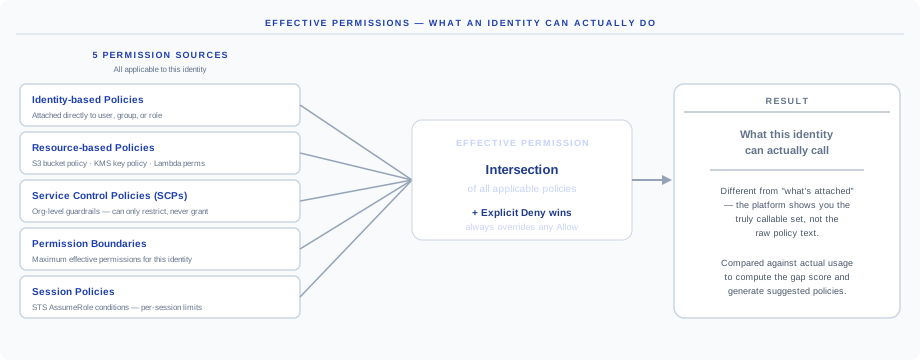
2. Usage analysis from activity logs. CloudTrail records every API call made in your AWS account. CIEM reads these logs — or their equivalents on Azure, GCP, and the other supported clouds — and builds a map of which permissions were exercised, by which identity, and when. A permission that appears in the effective permission set but has not appeared in any CloudTrail event in 90 days is flagged as unused.
3. Least-privilege policy generation. For each identity with unused permissions, CIEM can generate a suggested replacement policy that contains only the permissions that were actually used. This gives engineers a concrete, actionable change rather than an abstract "reduce permissions" recommendation.
The numbers in practice
Across accounts we have analysed, the average gap between granted and used permissions breaks down as follows:
| Identity type | Granted permissions unused |
|---|---|
| Service accounts (Lambda, ECS, EC2 instance profiles) | 94% |
| Cross-account roles | 91% |
| Human IAM users | 87% |
| Federated identities (SAML, OIDC) | 83% |
The highest gap is consistently in service accounts — the identities most often forgotten after the feature they were created for is deployed and the team moves on to the next thing.
What to do about it
The goal is not to achieve zero unused permissions immediately. That would require rewriting every IAM policy in your account simultaneously, which is operationally infeasible and will break things. Instead:
Start with the highest-risk identities. Shadow admins — identities that can reach admin-level access without holding an admin role — are the highest priority. A service account that can assume a role that can assume another role with iam:* permissions is a three-hop privilege escalation path. CIEM surfaces these chains; fix them first.
Enforce for new identities. The easiest permission to remediate is one that was never granted. Add a review gate to your IAM policy creation process that requires justification for any permission that has not been used in the last 90 days in a similar role. This does not fix existing debt, but it stops new debt from accumulating.
Automate the generation, not the application. CIEM can generate least-privilege replacement policies automatically. Do not apply them automatically — have a human review the suggestion for operational correctness before switching. What looks unused over 90 days may be used on a quarterly or annual cycle.
The cost of a false-positive access removal is a production incident. Generate automatically, apply carefully.
The 90% figure is not a problem you can fix in a sprint. It is a long-running hygiene practice, and the right tool makes continuous progress measurable instead of invisible.